
Vitamin B12 appears on the specification sheets of many nutritional yeast products, but the way it gets there is not always the same.
For food manufacturers, plant-based brands and product developers, the distinction between added and fermentation-derived B12 can be relevant to organic positioning, formulation, ingredient declarations and product storytelling.
Although “naturally occurring B12” is widely understood, fermentation-derived B12 is the more precise description. Vitamin B12 is produced by certain microorganisms rather than by plants or yeast themselves.
This article explains the two approaches and what each can mean in commercial food development.
The fortification route
Vitamin B12 is commercially produced through microbial fermentation, then recovered, purified and standardised as a vitamin ingredient.
In a fortified food, this separately produced B12 is added during manufacturing, either directly or as part of a vitamin and mineral premix.
This is a well-established approach. It allows precise dosage and is widely used in breakfast cereals, plant-based drinks, supplements and conventional nutritional yeast.
Yeast does not independently produce nutritionally significant amounts of vitamin B12. When a conventional nutritional yeast contains a high declared B12 level, the vitamin has generally been added during or after manufacture.
The fermentation-derived route
Some ingredients take a different approach by developing B12 as part of the ingredient-production process.
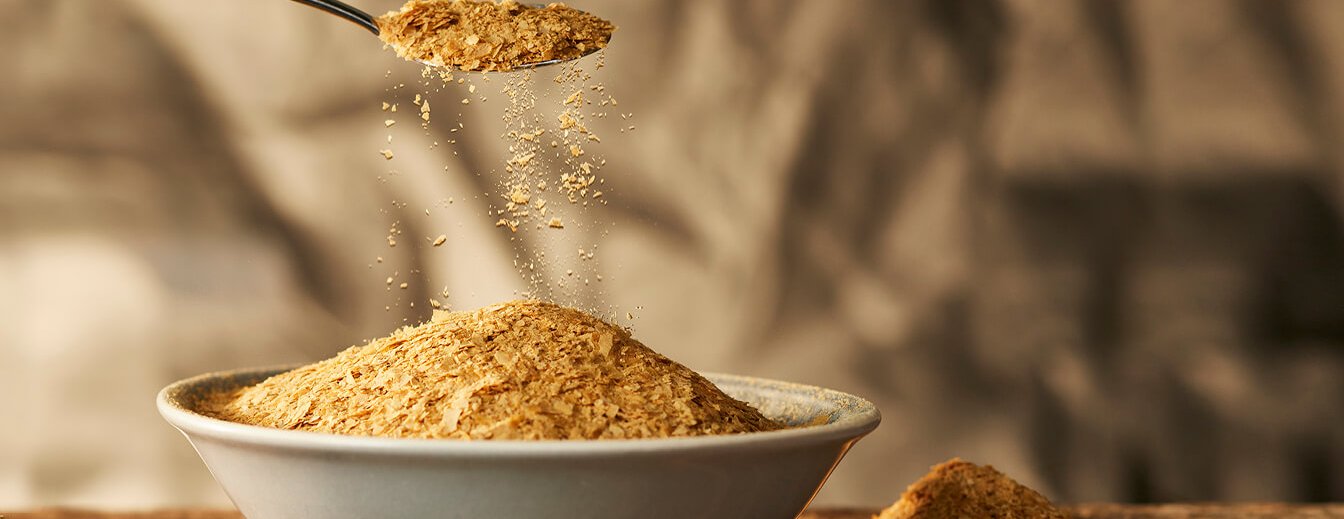
Bioreal® Organic Vitamin B12 Yeast Flakes are one example. Selected natural, non-GMO microorganisms are cultivated using organic raw materials so that vitamin B12 is formed through fermentation. The resulting organic fermentation product is then incorporated into the yeast-flake ingredient.
This creates a certified organic inactive yeast flake in which the B12 originates from the production process, rather than from a conventional vitamin preparation added to the finished flakes.
Why the difference matters
Fortification is a practical and widely accepted way to introduce B12. However, for products built around certified organic ingredients and carefully considered ingredient stories, the route through which a nutrient is introduced may carry additional significance.
Organic positioning
A fermentation-derived source produced using organic raw materials may provide a more coherent fit for products positioned around certified organic ingredients.
Ingredient strategy
The source and method of incorporation may influence formulation decisions and the finished ingredient declaration. The correct declaration should always be confirmed for the final formulation and intended market.
Product storytelling
Plant-based and nutritional brands increasingly communicate not only the nutrients their products contain, but also how those nutrients are produced and introduced.
Multiple formulation functions
Bioreal® yeast flakes contribute more than B12. They also provide protein, savoury flavour, colour and dry matter, potentially allowing one ingredient to perform several roles within a formulation.
None of this makes conventional fortification inappropriate. It means manufacturers have different routes available, and the best choice depends on the product’s nutritional targets, certification requirements and market position.
Practical points for formulation
Where B12 forms part of a product’s nutritional proposition, several factors should be assessed early in development:
- The confirmed B12 content of the ingredient
- The proposed inclusion rate
- The resulting B12 level in the finished product
- Nutrient stability under the intended processing and storage conditions
- The flavour, colour and texture contributed at the required inclusion rate
- Organic certification and ingredient-declaration requirements
- Labelling and nutrition-claim requirements in the intended market
Bioreal® Organic Vitamin B12 Yeast Flakes contain:
- 45 µg of vitamin B12 per 100 g
- 30.4 g of protein per 100 g
- Approximately 2.25 µg of vitamin B12 per 5 g reference quantity
The suitability of any nutrition content or health claim must be assessed using the finished product, its serving size and the applicable requirements of the market in which it will be sold.
Choosing between the two approaches
Conventional fortification may be the appropriate choice where a precise standalone dose is required or where organic positioning is not a priority.
Where a product is being developed around certified organic ingredients, plant-based positioning and a more integrated ingredient story, fermentation-derived B12 may provide a more natural fit with the overall formulation.
The important distinction is not that one method is inherently good and the other bad. It is that they represent different approaches to introducing B12, with different implications for formulation, certification and product positioning.
Bioreal® Organic Vitamin B12 Yeast Flakes are manufactured by Agrano in Germany and supplied in Australia by MH Bioreal Organics.
Evaluating B12 yeast flakes for an application?
Current specifications, certifications and technical documentation are available to verified commercial customers on request. Request a sample or discuss your application with our team.
Sample availability varies. Where stock is not held locally, samples may need to be ordered from Germany and can take several weeks to arrive.